See my Curriculum Vitae for an overview of my professional interests.
Background
I was born in Peoria, IllinoisPeoria is situated in the Illinois River Valley. The hilly landscape is beautiful and the Rust Belt vibes are strong. 
and currently split time between Berlin, Germany and Turin, Italy.Turin is a peculiar city in the foothills of the Alps. It is part aristocratic and part post-industrial. The myriad of local businesses are a joy to discover. 
The interim years were spent in Iowa → Chicago → New York City → Berlin.
I spent the majority of my life working as an artist, a college professor, and a software engineer. My curiosity drives my research, which focuses on the structure and transmission of information, the social impact of technology, digital art, and the nature of computation.
The internet was built to connect people. If what you see on Beyond the Frame resonates, please consider my open invitation to connect via eMail. You can also find me on Mastodon or Twitter.
This Website
Beyond the Frame was established on Tumblr in 2011. The service, established in 2007, was experiencing significant growth and featured my humble blog, which made me pretty popular for awhile. I’ll import those old posts to this version of the blog in due time.
The current website is a collection of thoughts that cover strategies for #doing, on science and technology studies (#sts), #personal updates, #informatics and computer science, the #suchness of knowledge, and #tools for thinking. It was made using:
- Blogging: Perun
- Layout: Tufte CSS & Tachyons
- Timeline: modified CSS by Niels Voogt
The source code is here.Special thanks to the tool-makers: Dave Liepmann for the original Tufte project and Jake Zimmerman’s work with Pandoc to ensure these sidenotes display correctly.
I stole ideas from:
- Brutalist Web Design by David Bryant Copeland
- Everyday Information Architecture by Lisa Maria Marquis
- Tom MacWright
- Martin Kavalar
How I Read
Consider buying physical books on IndieBound.
eBooks
I always have my nose in far too many books. I prefer eBooks because I often search through my highlights. Furthermore, e-ink readers are generally lighter and more ergonomic to use with one hand. They are easy on the eyes even with the sun overhead or in the depth of midnight.
Unfortunately the vast majority of eBooks are locked down and distributed in a way that is hostile to both authors and readers. I have compiled an array of ethical sources.Leanpub empowers authors and makes the experience joyful for readers. eBooks.com is considered best by Ethical Consumer and offers a DRM Free seach. Smashwords “does not publish works containing digital rights management schemes that limit the customer’s ability to legally enjoy the author’s work.” Tricycle distributes wonderful books on Buddhism. I have two sources for classic texts. Standard eBooks embodies the care and attention that classic books deserve while Project Gutenberg offers the widest selection. The Free EBook Foundation does some interesting work to make Gutenberg a more robust platform. For books on programming and computing, two publishers are distributing beautiful DRM-free eBooks: Manning and The Pragmatic Programmer. Unfortunately, O’Reilly, once a trail-blazing publisher in tech, is no longer selling books. I’m not familiar with open platforms like Open Libre and Open Book Publishers, but they look promising.
Please consider these the first stop for any eBook purchases.
I go into much more detail and offer more recommendations in my post How Ebooks Have Poisoned Electronic Ink. I’d love to hear people’s feedback on where they buy eBooks on the web.I generally check the author’s site before I buy a book in hopes I can pay them directly for their work. Bookshop (using Hummingbird) and River Dog Book Co. (using Mymustreads) are two storefronts with alternative readers that I’ve considered but never used.
With a Little Help From My Friends
I read blogs and periodicals using an RSS/Atom reader, Feedly. RSS is a much better way to get your news than social media sites. I also use it to keep track of my friend’s writings. Here’s a list of friends by subject category - each ordered by how often they post.
- The Art of Living: Khurram Naik, The Compass Needle, Meanwhile, Back in Peoria
- Computing and the Humanities: Knowing and Doing, Veit Heller, esoteric.codes, Modulo Lotus, Daniel Bachler, John Jacobsen, Ryan Singer
- Programming: Jessitron, Matt Horan’s Blog, See Spot Code
- Music & Art: Esthetic Lens, Martina Della Valle, Travelogue by Jon Sonnenberg, Sharon Hoyer @ Streetsblog and Newcity Stage, Nathan Woleck, South Street Dungeon
I’m currently experimenting with saving all my highlights on Readwise. I’m enjoying the integration across different platforms so far.
How I Do My Computing
This entry is inspired by Richard Stallman’s How I Do My Computing
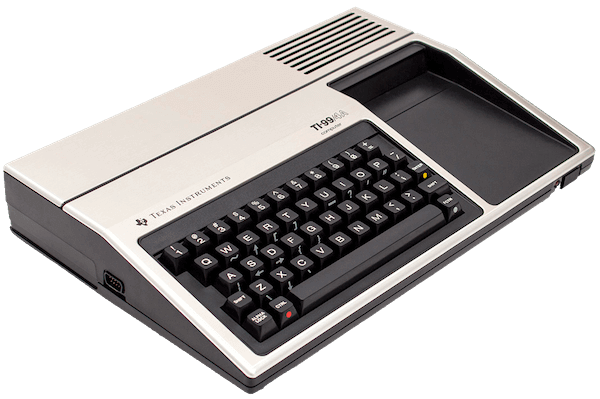
My family’s first computer was a Texas Instruments 99/4a (pictured above).I was quite young so all of my time was spent playing games. It was my introduction to BASIC - every TI booted with the programming language as an option. 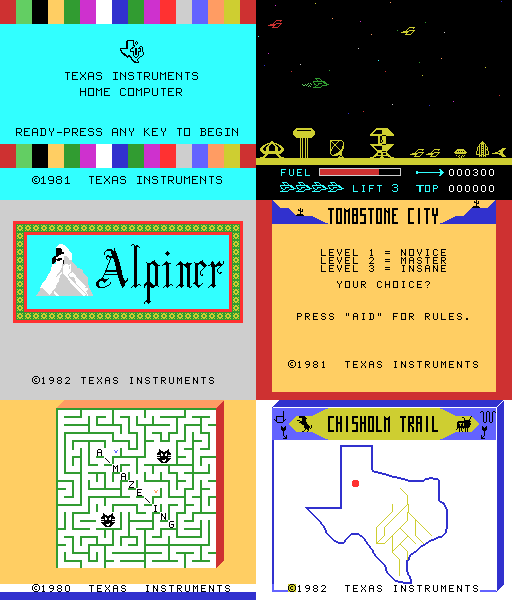 Some of the software available for the 99 4/a. From 99er.
My grandparents found one at a drastically reduced price during the “home computer wars” circa 1984. Computers have been central to my art practice and intellectual discourse ever since. Here’s how it looks today.
My Computer
Most of my hardware decisions are rooted in an effort to source ethical tools. The compromise between ethics and practicality landed me at a Hewlett Packard Dev One running the Pop!_OS flavor of Linux. I’m very happy with both.
I use an Apple iPhone as a smartphone. I never owned a tablet.
What I Do On My Computer
Most work begins as text. Lots of research and writing - uncovering concepts, having conversations, and connecting ideas. The work manifests on the web as experiences that span text, music, and video.
My Tools
I live in Emacs and Weechat. The vast majority of what I do on my computer is manipulate text. I switched back to text tools a few years ago. I found that it helps me focus. Since the software is built for text input, they are also much faster to use than mouse-driven programs. It’s simple math: ten digitsWell, nine fingers since the spacebar occupies two thumbs.
vs. one pointer.
Browser: Firefox with EFF’s Privacy Badger (desktop), Brave (mobile), & EWW (Emacs) - all are set to use DuckDuckGo for search.
eMail: Runbox is based in Norway, a country that provides strong privacy regulations. The service is powered by hydroelectricity and endorsed on Ethical Consumer.
Messaging: Weechat gets me to Slack, IRC, Google Chat, Twitter, and Mastodon. So that’s where I spend most of my time. On mobile I prefer Signal, but can also be found on iMessage and Whatsapp.Large proprietary services running on closed protocols introduce a number of concerns. My current response is to limit their use and encourage others to move to better solutions.